What is the difference between bills of exchange, promissory notes, cheques, bank notes, financial/commercial instruments, giros and all other forms of cash, i.e. money? Are all types of loans fraudulent in so many ways? Are all direct debts fraudulent in every way? There is no difference between any of them; they are all the same, even though different words are used to confuse people.
Many people walk around blindly every day, not having a clue where their cash comes from, who creates it, how it is created, who the true credit holder is and who the true banker is. Here we are to help you understand this.
Promissory notes and bills of exchange, i.e. financial instruments, commercial instruments, legal or lawful tender instruments and all other instruments, are not independent payment undertakings (debt obligations).
They are all one and the same thing: the maker/drawer pays the payee/seller or representative. They are codified under the Bills of Exchange Act 1882, which was developed and interpreted by the courts and the High Court ruling of Lord Denning.
As the real contract is only between the two parties to this instrument, any third party in a court case acts as trustee only.
The use of Bills of Exchange / Promissory Notes
Historically, the promissory note was used as a method of financing and supporting all types of domestic and international (cross-border) trade. Nowadays, however, bills of exchange and promissory notes, as well as many other instruments, are used for cross-border financing.
Anyone who fully understands bills of exchange can use them in any country. Bills of exchange/promissory notes, i.e. financial instruments, commercial instruments and legal or lawful tender, are not independent, as they are all seen as cash notes. Bills of exchange, promissory notes, bank notes, giros, cheques and all types of legal documents are instruments that you sign and date. If your company or employer tells you that it is a contract, it is not; it is in fact a financial instrument, a promissory note, which is a bill of exchange.
Everything comes from the original promissory note, which was previously known as an IOU. This is an important characteristic of the many different types of financial instrument out there. By law, a contract must have three parties: you, the agent, and a witness to the agreement to sign the contract freely. This then becomes legally binding.
This is the law of the land under the Bills of Exchange Act. If they are on other instruments, such as purchase agreements or other underlying transactions, they are generally always excepted, unless a mistake is made on the instrument.
In this case, the drawee can send it back to the maker and request that they correct the mistake. However, the bill, or the person to whom the bill is made out for payment, cannot be refused by the drawee or the payee. If they want to be paid in cash, they must accept the promissory note, as clearly stated in the law on bills of exchange (1881, India & 1882, England). To receive full payment or whatever payment has been agreed between the two main parties (the drawer and the payee), the party wanting payment must create the instrument to be discharged to the party to whom it is payable.
For example, if a buyer wants to purchase goods or property from a seller with the intention of paying in six months or upon demand in full, the purchase agreement will be between the buyer and the seller and not the bank or the drawee, who are public servants within the banking office and are all bound by bills of exchange.
Any bank worker who does not do so is therefore taking full personal and commercial liability for breaking the constitutional laws of the land. The BOE is therefore committing an intentional tort by their own actions and inaction.
In other words, a drawee cannot refuse a form of payment or claim that they are not bound by it; they have no authority to do so.
The contract is not with the bank worker, who is merely your employee as a drawee. It does not matter what titles they hold; they are all drawees. Promissory notes and bills of exchange
Bills of exchange and promissory notes are not independent payment undertakings (debt obligations) from one person to another.
They are codified under the Bills of Exchange Act 1882 and have been developed and interpreted by the courts, as High Court Judge Lord Denning clearly stated.
The use of Bills of Exchange / Promissory Notes
Historically, the IOU and the promissory note were bills of exchange, which were financial instruments used to finance and support domestic and international (cross-border) trade. Nowadays, however, bills of exchange and promissory notes are mainly used for cross-border financing. They are also used in your own country, especially England, as this was the birthplace of all good laws. Bills of exchange come in many forms and represent cash, i.e. money.
Bills of exchange and promissory notes are not independent, as many people believe. This is an important characteristic of these financial instruments. If they are attached to other instruments, such as purchase agreements or other underlying transactions, they are generally accepted as payment in full. Therefore, signing and dating this instrument releases the full funds to the seller's account.
For example, if a buyer wants to purchase goods, property or services from a seller with the intention of paying in full or in instalments over six months, the purchase agreement will only be between the buyer and the seller. Not the drawee, the bank workers, the estate agents or the solicitors, but all bank workers are your employees. Therefore, these individuals are acting as your fiduciary/trustee in your public office, as the bank is our public office. This is a fact that not many people know, let alone understand.
The buyer will agree to make part or full payment through a bill of exchange, which can be guaranteed by the drawee bank. The bank is only permitted to pass the payment to the seller's account. They cannot interfere with or stop the transaction between the seller and buyer, nor can they refuse bills of exchange. As clearly stated on the bills of exchange, they are cash. According to the Lord Denning judgement, a bill of exchange is to be treated as cash. Once tendered (signed), the instrument has to be executed in this English court, as a bill of exchange is to be treated as cash.
In this case, the seller/payee would arrange for the goods to be delivered or release the property to the buyer. The buyer/drawer/maker of the bill would then draw a bill on the bank (drawee) to honourably discharge the part or full payment to the seller/payee. If they stop this transaction, they are interfering with the seller and buyer. This constitutes a tort, treason and wilful fraud, and any document they produce is also subject to the "Uttering Laws".
By doing so, the bank/drawee will incur full personal and commercial liability for that 'exchange', in favour of the seller/payee receiving payment in instalments or in full. The bank can only transfer the funds to the correct account; it cannot stop this transaction from one party to another as it does not have the power or authority to do so. Always be mindful of what you do to others.
A bank cannot give you credit as it has none; it merely holds assets, trusts, funds and cash for safekeeping. It cannot lend you anything as it has nothing to loan you. The true credit holder is the drawer, the maker of the note (i.e. promissory note). This bill is then used to access the trust of the drawer, i.e. the person who made it, as clearly stated on the Bank of England webpage. The key words are 'note' and 'trust', as the drawer has many different trusts in his or her name, as well as many numbers. The drawee has only three duties, responsibilities and obligations within our bank offices: to pass on the payment to the seller's account. Failure to do so constitutes a breach of their fiduciary duty as a trustee.
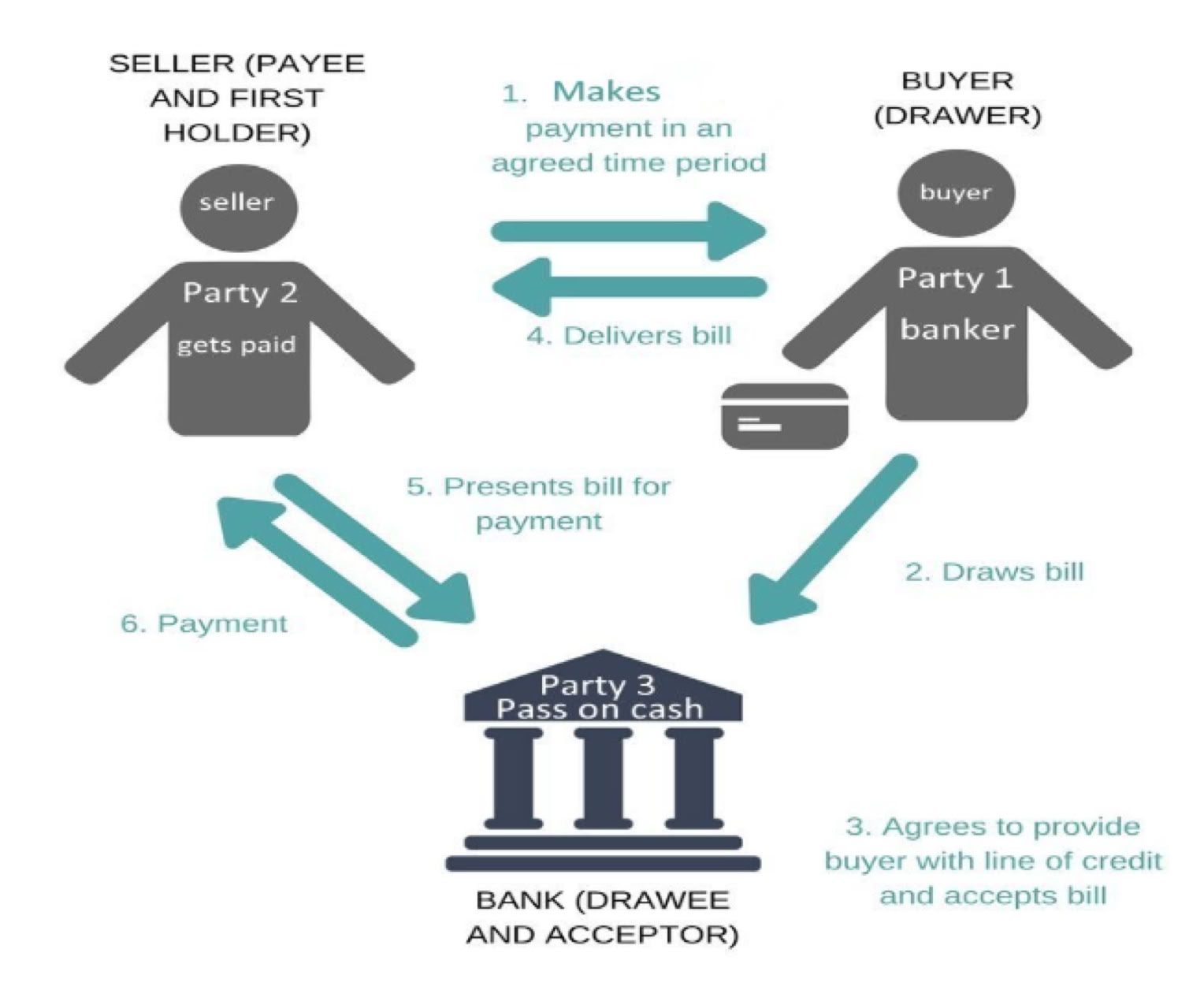
As the illustration clearly shows, who is who?
And who does what? The banks/drawee/acceptor cannot give you any credit as they have none. The bank cannot loan or lend you anything as they have nothing to loan or lend to you. This is 100% fact. Only the man or woman who holds all credit can contract with anyone for an unlimited amount. This is also 100% fact as they are the creator of all credit and the only true holders of their private credit in their private trust. They are then the creditors who are the beneficiaries of their own private trust and all the trust accounts they hold. Without them, there would be no credit. What do these other societies want you to sign? Think carefully. All securities lie with the drawer/maker/creator of all types of credit. The seller/payee seeks this payment upon agreement with the drawer/maker. This is not the responsibility of the bank or its employees. The seller (payee) wants to sell something, such as property. This can be anything from a pencil to a house, a horse, a car, a bike or a washing machine. The seller wishes to sell this property because they need or want the cash. They have the full right to do so under banking law. The seller/payee and the drawer/maker can enter into a contract with each other as many times as they wish, and the drawee must fulfil their duties or be in breach of their duties and office.
By stopping or interfering between the two parties to the original agreement, the Buyer (2) takes full personal and commercial liability, as the Drawee has no say in the matter, since the agreement was not with the Drawee. The buyer (2) drawer wishes to purchase the property from the seller (1) payee. Once they have agreed to this exchange of value for value, the substance of the agreement is the promissory note, i.e. cash. The seller agrees to accept this as part or full payment. As the contract is only between the seller and the buyer, the payee and the drawer, and not the drawee, the drawee has no say.
The drawer can pass the instrument to the payee, who then endorses it by signing the back of the instrument like one signs a cheque. They then hand it to the drawee bank, which puts the instrument into the seller/payee's account. The seller/payee can then access the cash immediately. However, this is not necessary; a simple letter stating that the seller/payee will accept part or full payment on this instrument is enough. They must print their name and sign it. This letter should be sent with the instrument to the drawee bank, which must release the funds into the seller/payee's account. Alternatively, with the seller's agreement, the drawer can post the instrument to the bank for payment into the seller/payee's account. The drawee must do this or face legal action. The Bank of England is a public office, so all banks worldwide are public offices. All those who work within them are mere drawees. They act as servants, fiduciaries and trustees. However, most bank employees are corporate men and women, and are not permitted to hold any of our civil or public offices.
The bank, as the third party, must accept this instrument and pass on the payment, either partially or fully, from the buyer, who is the drawer and maker of the instrument, to the bearer of the bill. The bearer has full legal rights and entitlement to the funds, as they are the beneficiary of their trust accounts. These funds must then be passed on to the seller, who is the payee. It's that simple, really. All parties are bound by the Bills of Exchange (BOE).
Definitions
All types of instruments contain an unconditional order (with regard to bills of exchange) or an unconditional promise or payment on demand (with regard to promissory notes/bank notes). The definitions are as follows, as per the Bills of Exchange Act 1882:
Bill of Exchange 1881-1882
"A bill of exchange is an unconditional written order, signed by the drawer/maker, addressed to the payee/seller, requiring the payee/seller to pay a sum certain in money to a specified person or to the order of a specified person, or to the bearer, on demand or at a fixed or determinable future time." (Great Britain, Bills of Exchange Act 1882). The instrument must have a penny stamp, as stated in section 34, sub-section 1 of the Stamp Duty Act 1891. The bearer can be yourself, meaning you can pay yourself or pay it to another person, or even gift it to another person. This person then becomes the bearer of the bill, meaning the seller/payee. Only the maker and the beneficiary hold full title to it and everything within it. They are the only person who can release the funds, assets, cash or money. This is because they hold full, unlimited credit, as they are the only person who can create this credit and are the only true credit holder.
Promissory notes
A promissory note is an 'unconditional promise', which is not subject to any conditions of any societies. It is a written document signed by one person, engaging to pay a sum certain in money to a specified person, or to the order of a specified person, or to the bearer, on demand or at a fixed or determinable future time. Bills of Exchange Act 1882. Part IV. The bearer can be you or the payee, who now holds the instrument. In either case, you are accessing your trust and paying either yourself or the payee.
All instruments are generally subject to same core requirements:
The instrument must contain an unconditional order or promise (demand, respectively). It must be written, completed in the correct area, signed and dated. It must be addressed to one person or company by another person or company.
The drawer/maker (the person making the order or promise/demand) must sign the instrument to indicate that the payee must be paid the amount clearly stated on the instrument within 72 hours. If the bank drawee does not do this, they become fully liable for the full amount of the instrument. The instrument must then be converted into cash and transferred to the account of the drawer/maker or the seller/payee, unless there is a spelling mistake or the penny stamp duty is missing. The bank drawee cannot keep the instrument or send it back unless there is a spelling mistake or the penny stamp duty is missing.
The instrument does not require the drawer or maker to pay the payee the amount clearly stated on the instrument.
All instruments must define the payment terms (through the order or promise/demand) and state whether payment is to be made on demand or at a fixed future time. The sum of money must be disclosed, as must the payee and the payment date. This will release the full funds to the payee. The drawee must not withhold this, as this would constitute a breach of their fiduciary/trustee duties and responsibilities as a public servant in all banks worldwide.
Promissory notes/Bills of Exchange and all instrument are all one and the same thing CASH. i.e money this holds substance and value.
1.Unconditional order of promise/demand
If the promissory note or bill of exchange is unconditional, then it will be considered a promissory note, because the promissory note comes from the IOU, which is the same as bank notes, which only come from the promissory note. There would be no bank notes if the blueprint for these was not the promissory note. In fact, a promissory note has more substance and value than a bank note. Bank notes are all printed on a printing machine, whereas a promissory note must be filled out by hand, signed and dated. This is how the bill is tendered, showing how much and to whom the payment is for. This is how all banknotes are created. We are therefore trading with each other, meaning we are entering into a contract. We do not enter into a contract with servants, fiduciaries or trustees; these are our employees. We hire them under the Bills of Exchange, and they are all bound by this constitutional law of the land. Therefore, all of our employees must show proof of the oaths they took to hold public office, including doctors, MPs and royals who want to enter our office of head of state. They all become servants, fiduciaries and trustees in our office and take direction and orders from us, as we are the government and govern all of them under this bill of exchange and TORT laws and the seven principles of public office.
1.In writing and signing by the drawer (BOE) the maker (PN)
With electronic communication methods such as email becoming more prevalent than paper documents, the Electronic Communications Act 2000 now means that a promissory note or bill of exchange could potentially satisfy the requirement for a paper-based signature. While electronic signatures could previously be used for bills of exchange and promissory notes in accordance with the 1882 Act, in many jurisdictions the 'original document' is required and electronic signatures may therefore be deemed invalid. This can cause problems when these instruments are transferred to other parties.
.
1.Time for payment
As mentioned earlier, the payment date can be defined as either a future date or on demand. However, when the event is 'indeterminate' or 'uncertain' (e.g. payment upon the occurrence of a political event), it is often best to consider the instrument a promissory note. Everything is a promissory note that you sign and date as the drawer, or maker, and true credit holder.
1.Sum certain
Even if an interest rate is charged, the 'amount due' should be clear. This is perfectly acceptable in bills of exchange and promissory notes. However, if the interest rate is 'fixed' or ascertainable rather than X% above LIBOR, it is often considered unclear.
This is because of the fraud surrounding LIBOR: the basic rate of interest used in lending between banks on the London interbank market, which is also used as a reference for setting the interest rate on all types of loans.
1.Governing law and jurisdiction
The governing law that applies to all chains between the parties involved, i.e. the maker, the acceptor (i.e. the drawee) and the endorser (i.e. the payee), can often be fairly complex when there are chains involved. The chain of contracts depends on the nature of the two parties (the drawer and the payee), the instruments, and the location of the parties. Such contracts must be valid in each local jurisdiction when dealing with trust, cash, money, funds, assets and wealth. Please refer back to the Bills of Exchange if in doubt. It does not matter where you live on this earth, nor in which country; wherever there is a bank, they are all bound by the Bills of Exchange — it's the law. This governs everyone, as everyone has their own true legal status, as clearly stated above.
Frequently Asked Questions
Can I negotiate or transfer Bills of Exchange or Promissory Notes?
Yes, by law, all instruments have to be transferable, whether negotiable or non-negotiable, including promissory notes, bills of exchange, cheques, bank notes and giros, as well as many other forms of payment. Payments can be made between the two parties involved, or even to oneself, into one's own account. The rights or title of these instruments can be transferred to other parties, the payee. A payee holder can receive a bill and become the bearer of the bill, provided they become the holder before it is overdue. Upon demand, if there is no set date, the bill can be cashed immediately, or the payee can pay themselves by putting the instrument in a few days later, or whenever they have time to do so, provided they are acting in good faith. This includes the acceptor (bank/drawee), drawer (buyer/maker), or endorser (seller/payee).
How does delivery work?
In order to fulfil a contract under a bill of exchange or promissory note, delivery must take place. This can be either actual or constructive delivery. Alternatively, it can be sent by Registered Post with Royal Mail or a private post company. The acceptor (drawee) must accept liability for the instrument, whereby the seller/payee signs the back of the instrument or sends a document stating that they accept the instrument as full payment. Once delivered, the contract of endorsement by the payee must be in writing and signed by the endorser/payee and written on the back of the instrument. This involves tendering the bill, meaning signing it for the full amount of the instrument. The payee/seller can also write a statement accepting the instrument as full payment. This endorsement can be with or without recourse (see our article on recourse and non-recourse payments and forfeiting). Look up the meanings of the words 'recourse', 'non-recourse' and 'forfeiting' to understand them fully.
How does payment happen?
Generally, the acceptor/drawee or maker/drawer of bills of exchange/promissory notes are liable to make payment to the seller/payee once the instrument is presented. The drawee must pass on the full payment, which can be made to a person acting on behalf of the holder (e.g. a collecting bank), or the drawer can pay themselves, provided that the holder treats such payment as discharging the payer's liability to pay the seller in full. As you are the beneficiary of your own private trust, it is your funds and cash that you can move to any of your accounts if you have more than one, or you can make a gift to someone else. However, the drawee must pay this to the person named on the bill. The drawee cannot decide who can and cannot receive this cash or refuse to accept it as payment for these instruments, which are bound by the BOE. The drawee has wilfully committed a tortious act. Breach of the office.
Meaning Of Endorser
It's to declare that you agreed to sign, meaning tendering the bill (a cheque or bill of exchange/promissory note) on the back to make it payable to the stated payee or drawee, who accepts responsibility for paying it forward. This clearly states who the instrument is to be discharged to. Hopefully, this simple explanation will help you to fully understand what a bank note is: a newly printed promissory note made by the drawer on the original promissory note, which is how the bank note comes into existence. Everything comes from the original promissory note, the bills of exchange, and other types of instruments are all still connected to the bills of exchange and promissory notes. The fact remains that England has been bankrupt since the public was notified in 1931, as have all banks worldwide. Therefore, all banks are operating under bills of exchange worldwide. This information has been withheld and suppressed from everyone.